Interrupts and the GIC
Configure a Zynq interrupt from its source to the processor, write a short ISR and analyze latency.
Interrupts and exceptions
An interrupt usually comes from a peripheral and is asynchronous to the running program. An exception is caused by processor execution, such as an invalid instruction or forbidden memory access.
The processor saves a minimal context, identifies the source, executes an Interrupt Service Routine, or ISR, and resumes the interrupted program. The vector table provides the entry points for processor exceptions.
The complete path
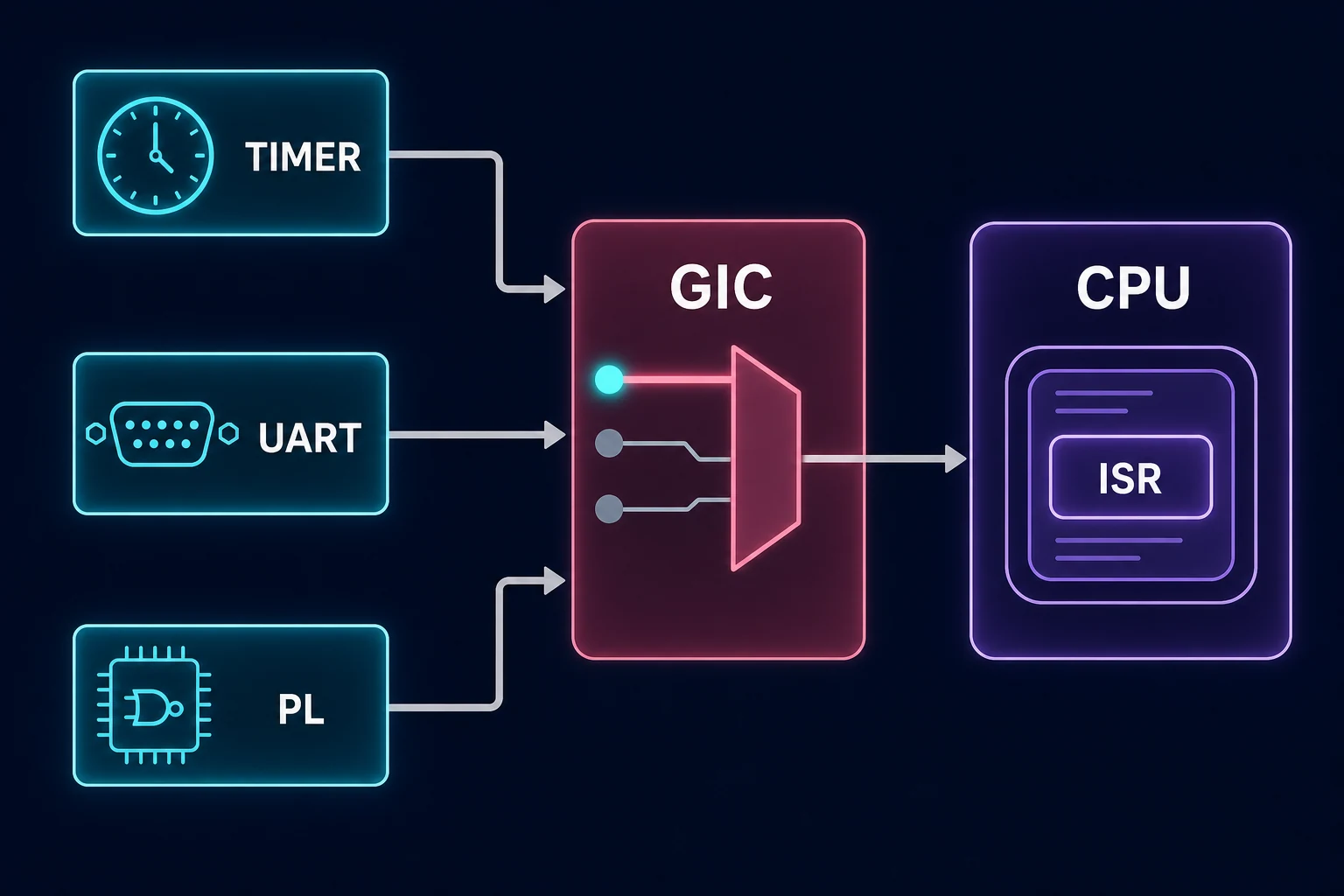
A timer interrupt crosses several layers.
- The timer detects an event and sets a status bit.
- Its local mask enables the interrupt output.
- The Generic Interrupt Controller receives the request.
- The GIC checks enable state, priority and processor target.
- The processor enters the common handler.
- The GIC handler calls the registered ISR.
- The ISR acknowledges the source before returning.
Enabling only the GIC is not enough. The peripheral source must also be enabled.
Initializing the GIC
The code uses XScuGic and connects its common handler to the processor exception logic.
XScuGic_Config *config;

config = XScuGic_LookupConfig(XPAR_SCUGIC_SINGLE_DEVICE_ID);
XScuGic_CfgInitialize(&gic, config, config->CpuBaseAddress);

Xil_ExceptionRegisterHandler(XIL_EXCEPTION_ID_IRQ_INT, (Xil_ExceptionHandler)XScuGic_InterruptHandler, &gic);
Xil_ExceptionEnable();
The Triple Timer Counter is configured in interval mode. A prescaler divides the input clock to obtain a slower timer rate. The ISR reads and clears the status, an operation called acknowledgement, then sets a flag.